Congratulations Dr. Hongyi Cai for successfully defending his PhD in Materials Science and Engineering earlier this month! Also, thanks for choosing the best kind of celebration (Cornell Dairy Bar Ice Cream)!!!
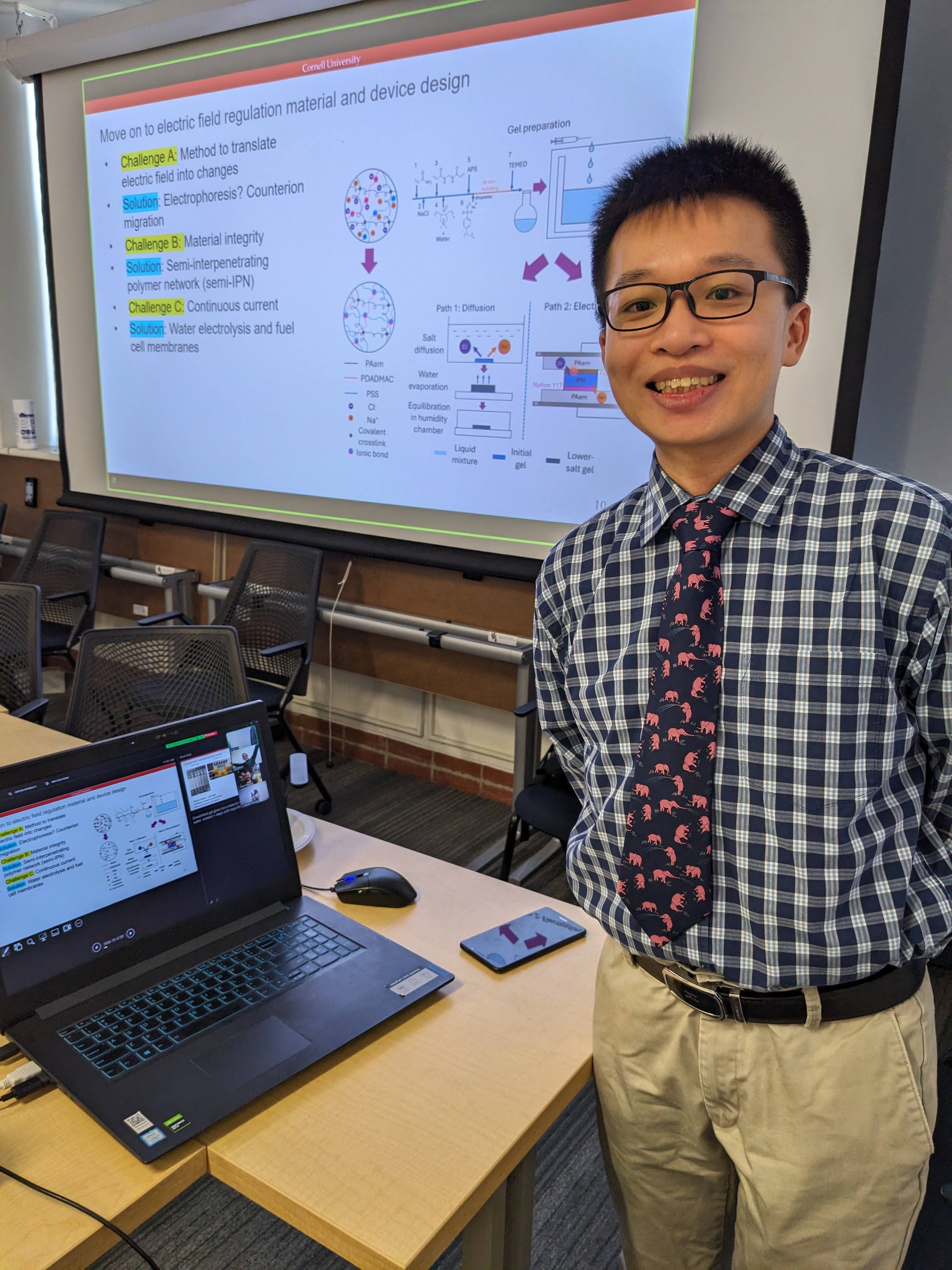

Congratulations Dr. Hongyi Cai for successfully defending his PhD in Materials Science and Engineering earlier this month! Also, thanks for choosing the best kind of celebration (Cornell Dairy Bar Ice Cream)!!!
Max Tepermeister and Si Chen participated Complex Active and Adaptive Material Systems Gordon Research Seminar and Gordon Research Conference at the end of January in sunny Ventura, CA. This year’s theme was Active and Biomimetic Materials That Embody Intelligence. Si presented her work on engineering mechanics and growth of plant leaves. And Max won best speaker at the GRS presenting on his ionic material and system modeling tool and its applications for designing soft robotic systems!

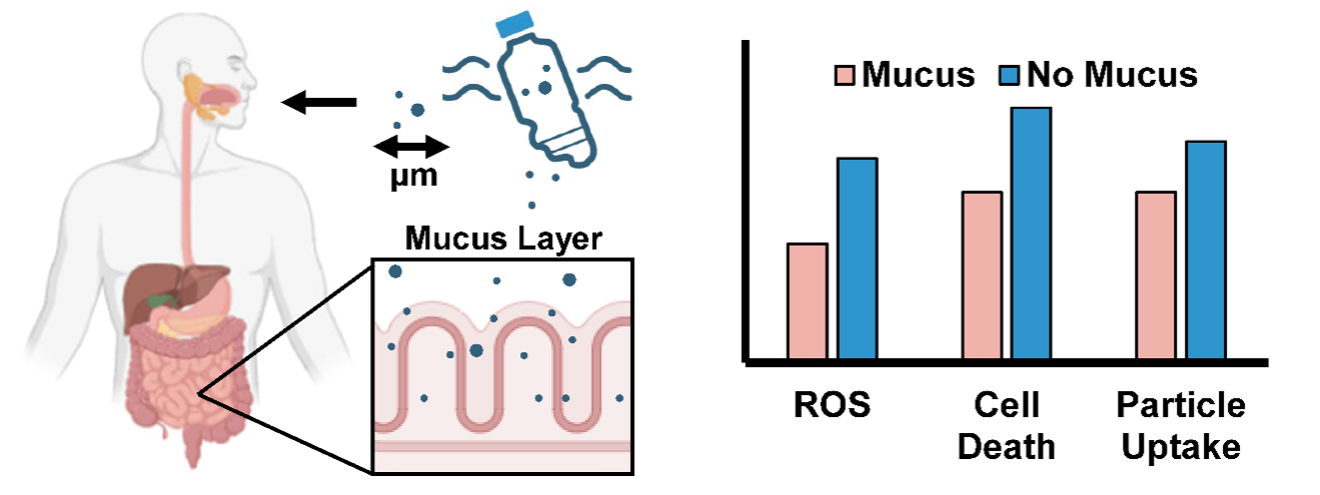
Our latest paper “The Role of Human Intestinal Mucus in the Prevention of Microplastic Uptake and Cell Damage” is now published in RSC Biomaterials Science. This work was led by PhD candidate Ellen van Wijngaarden, who is co-advised by Prof Ilana Brito of Cornell’s BME department. We used intact human intestinal mucus layers to best match in vivo material properties and study the effects of microplastics on cells. Our study investigated a broad range of microplastic sizes and materials and identified specific compositions that pose an increased risk to human health. This work highlights the protective role of the intestinal mucus layer in preventing cell cytotoxicity, inflammation, and particle uptake due to microplastics and the toxins they may carry.

And also, after only 12 years . . . unveiling our lab logo. Credit to Max for the design with support from Hongyi.

Welcome to our three new MMD lab members! In order of official joining . . . Zach Bernheimer is a first year MSE PhD student with a background in chemistry and computer science. Dr. Dongxu Liu is a postdoc with extensive experience in multiphysics constitutive modeling of soft materials, especially focusing on synthetic and biological gels. Shristy Sahu is a second year MSE PhD student with expertise in materials synthesis and experimental characterization.
Dr. Zhongtong Wang successfully defended his thesis just before Thanksgiving! Official congratulations hand shake from committee member Prof Yeo shown below.

A new paper by former MMD lab postdoc Rob Wagner and Prof Meredith Silberstein is now out in JMPS. This paper, “A foundational framework for the mesoscale modeling of dynamic elastomers and gels,” presents a mesoscale modeling approach for capturing the large deformation mechanics of elastomer and gel networks with dynamic bonds. This method greatly increases accessible time and length scales within the range of applicable polymers. The paper systematically compares the method to matched coarse-grained molecular dynamic simulations and existing theoretical frameworks.
Congratulations to ELMI postdoc and MMD group member Dr. Si Chen for winning the Fleming Research Fellowship from the Weill Institute for Cell and Molecular Biology! The Fleming Research Fellows program was established in 2008 to support talented young women and men at Cornell who are doing cutting-edge research in basic biomedical sciences and are planning careers in biological or medical research. This highly competitive fellowship comes with up to three years of full time research support.
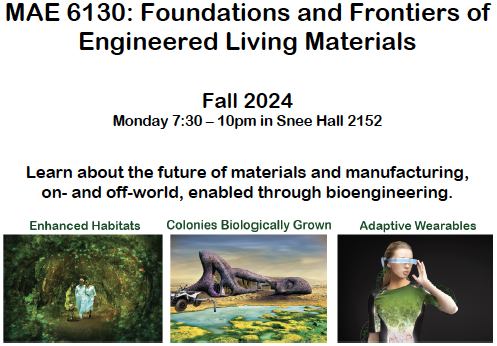
This course enables understanding of emerging research and techniques in the ELM field. Additionally, it provides the opportunity to learn how to brainstorm, resolve, and persuasively convey your own research ideas.
 Mechanics for Material Design